Showing posts with label Pallet Rack. Show all posts

Tuesday, October 18, 2011

Safety Considerations of Pallet Rack

Because of the size and weight of pallets, important safety factors have to be considered at all times:

  1. Pay attention to any loose components in the pallet rack system, and take the time to report any damage in the pallet rack frame; such frame damage could cause the pallets to fall.
  2. It is the owner’s legal responsibility to communicate this important warning to all who are around storage racks:
    “Never climb on racks during or after assembly. Storage racks are not designed to be stepped on or climbed on. A slip or fall may result in serious injury.”
    It is especially important to have highly visible warning signs if the pallet rack system is used in retail environments, such as wholesale centers, where the public is present.
  3. Use only quality pallets that are not damaged. To save money, or perhaps from neglectful management, some warehouses use pallets until they become faulty and dangerous. Regular inspection of pallets for broken or fractured planks or stringers, protruding nails, and missing support blocks is essential. Damaged pallets can cause loading and unloading problems; for example, loose stringers can get hung up on the pallet racks, which can cause loads to fall from high positions. Also, faulty pallets can cause obstruction problems in flow systems by jamming certain pallet rack designs.
  4. Always ensure that the proper motorized equipment is being used for the application.
  5. Do not obstruct the end of aisles by staging pallets in these areas. Doing so can cause severe and potentially fatal injuries and accidents.
  6. Never overload or exceed the recommended load specifications for a racking system. Overloading may cause a catastrophic failure of your storage rack system.
  7. Rack Audits (safety checks) should be performed on a regular basis by a qualified inspector familiar with RMI design and safety standards to make sure all aspects of system are up to 100% operationally safety.

Thursday, September 22, 2011

Introduction of Selective Pallet Rack/Racking Systems

       The selective pallet rack/racking is the most common pallet racking system in use today. It’s typically come in one of two configurations: a roll formed, or clip-in configuration, and a structural bolt-together configuration. Roll formed selective rack is most commonly manufactured in a "teardrop" style. The nickname “teardrop” comes from the fact that the holes on the column of the upright are shaped like a teardrop. Pallets then rest on the horizontal load beams that are held in place by mounting clips. Because the clips on teardrop configurations can be quickly moved, the shelves can be easily adjusted to different heights to accommodate various load sizes. This is convenient for a warehouse that needs to store a wide variety of product sizes.
       Structural pallet rack systems are very similar to roll formed pallet rack systems except the horizontal load beams are attached to the uprights with bolts and have much greater weight-bearing capacity. Also, structural pallet racking can be designed into the structure of the building itself, so that the upright columns are simultaneously used to support the roof of the storage facility, in which case the structural pallet rack uprights replace the storage building’s vertical support I-beams.

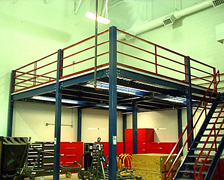
       One of the most popular forms is the mezzanine rack system. In this kind of pallet rack, it is often used in shops and similar spaces for storage of tools or materials. The high roof of the shop is ideal for a mezzanine, and offices can be put either below or above it. Mezzanines are frequently used in industrial operations such as warehousing, distribution or manufacturing. These facilities have high ceilings, allowing unused space to be utilized within the vertical cube. Industrial mezzanine structures are typically either structural, roll formed, rack-supported, or shelf-supported, allowing high density storage within the mezzanine structure.

Wednesday, September 21, 2011

How to Choose a Suitable Pallet Rack?

       The pallet rack is a material handling storage aid system designed to store materials on pallets. Although there are many varieties of pallet racks, all types allow for the storage of palletized materials in horizontal rows with multiple levels. Being the least expensive and cost increasing with storage density, pallet rack creates some level of increase storage density with the least dense. Forklift trucks are usually an integral part of any pallet rack system since they are usually required to place the loaded pallets onto the racks for storage. It is an essential and ubiquitous element in most modern warehouses, manufacturing facilities, retail centers, and other storage and distribution facilities.

       Because of the size and weight of pallets, important safety factors have to be considered in choosing the pallet rack:

  1. Keep an eye on any loose components in the pallet rack system.
  2. Bear the following statement in mind!
    “Never climb on racks during or after assembly. Storage racks are not designed to be stepped on or climbed on. A slip or fall may result in serious injury.”
  3. Use only quality pallets that are not damaged.
  4. Always ensure that the proper motorized equipment is being used for the application.
  5. Do not obstruct the end of aisles by staging pallets in these areas.
  6. Never overload or exceed the recommended load specifications for a racking system.
  7. Rack Audits should be performed on a regular basis by a qualified inspector.